幻夜
4,220-year-old rock art in SW China’s Yunnan reveals early cultural links with Southeast Asia_我的网站

一 | 中新网拉萨8月21日电 (记者 赵朗)从城市到乡村,从家庭到社区,“民族团结一家亲”的理念已融入日常生活的点滴之中。
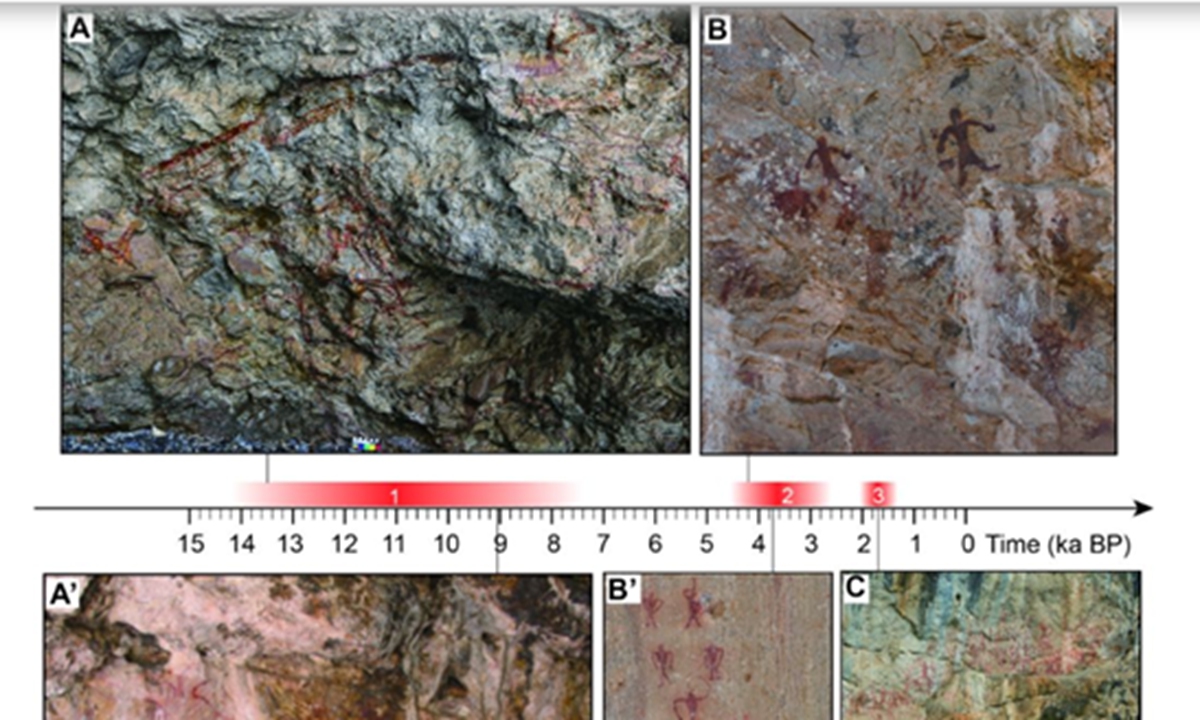
Timeline of the major painted rock art groups in Southwest China: A-A′: Jinsha River rock art; B-B′: Mangguan-Cangyuan rock art; C-C′: Zuojiang rock art Photos: Xinhua
Chinese researchers have obtained the first absolute dates for rock paintings at the Mangguan rock art site in Southwest China's Yunnan Province, pushing the known history of rock art created by prehistoric settled communities in the region back to about 4,220 years ago. The paintings also suggest cultural interactions more than 4,000 years ago between Southwest China and civilizations along the Yellow and Yangtze rivers, as well as possible exchanges with neighboring parts of Southeast Asia, including present-day Myanmar, Thailand and Vietnam, a member of the research team told the Global Times.
The Yunnan Provincial Institute of Cultural Relics and Archaeology, in collaboration with Nanjing Normal University and other institutions, have recently made a significant archaeological breakthrough. Through systematic surveys and uranium-thorium (U-Th) dating at the Mangguan site in Gengma county, the research team obtained the first absolute dates for the site's rock paintings, tracing rock art created by prehistoric settled communities back to around 4,220 years ago.
The findings were recently published in the international journal
Journal of Archaeological Science: Reports.
The Mangguan rock paintings represent one of the best-preserved prehistoric rock art sites in Yunnan. The research team presented high precision U Th dating of carbonate accretions that stratigraphically overlie the painted motifs at the Mangguan site, according to the paper published in the journal.
The dating results show that carbonate deposits overlying a human figure yielded a corrected age of 4,240 ± 19 years before present, confirming that ancient people living in the region had already produced mature figurative art at least 4,220 years ago, Wu Yun, first author of the paper and an associate researcher at the Yunnan Provincial Institute of Cultural Relics and Archaeology, was cited by the Xinhua News Agency report as saying.
Dating results from 11 samples taken from different motifs clustered between about 3,907 and 3,056 years ago. By comparison, the Cangyuan cliff paintings had previously been dated to roughly 3,800 to 2,700 years ago. The Mangguan paintings are therefore significantly older, filling an important chronological gap in the region's artistic record before the Cangyuan phase.
Shao Qingfeng, corresponding author of the paper and a professor at the School of Geography at Nanjing Normal University, told the Global Times that previous estimates dated the Mangguan rock paintings to a little over 3,000 years ago based mainly on imagery and comparisons with similar regional sites. Using microsamples of secondary carbonate deposits overlying the paintings, researchers have now obtained a precise minimum age of about 4,220 years before present without damaging the rock art.
The findings and the establishment of this chronological framework not only strengthen the archaeological foundation for studying rock art in Southwest China, but also provide a direct reference for rock art sites across Southeast Asia that have yet to undergo systematic dating, Shao said.
The findings may also challenge long-held perceptions of Southwest China around 4,200 years ago - roughly the era of the Xia Dynasty (c.2070 BC-C.1600 BC) - and help fill a key gap in understanding the pluralistic yet integrated development of Chinese civilization.
Shao said that while academic research has traditionally focused on the Yellow River and Yangtze River basins as cradles of early Chinese civilization, sites such as Mangguan and Cangyuan show that stable and culturally active communities also thrived in mountainous Southwest China. The newly established rock-art chronology brings an artistic dimension to the broader narrative of China's enduring cultural development.
Moreover, stylistic similarities suggest that Southwest China maintained exchanges with the Yellow River and Yangtze River regions and with early societies in Southeast Asia, providing material evidence of cross-regional interaction more than 4,000 years ago.
。西藏各族群众共居、共学、共事、共乐,随处可见各族群众手足相亲、守望相助的温暖日常。
现居住于西藏日喀则市桑珠孜区的明国禄,从事国画艺术创作,是日喀则市书法家协会会员,因艺术与西藏结缘。

二 | 2002年,当时这位青海小伙从新疆乌鲁木齐毕业后来到了日喀则,怀揣着艺术之梦在此扎根。
初到日喀则,明国禄便开始自学藏语。他随身备好笔记本,记下日常用语、基础语法,一点点积累练习。

三 | 2016年,明国禄结识了如今的爱人,孩子已经在读小学了。

四 | 他说:“爱人是日喀则人,不懂汉语,所以我们基本都用藏语交流。”
图为明国禄(右一)与家人在景区合影。明国禄供图
长期的朝夕相处,让他完全融入当地生活。糌粑是家中常备食物,酥油茶他也能够亲手制作,家里大部分的饭菜也都由他亲自操持。逢年过节,夫妻俩都会回到日喀则市桑珠孜区江当乡,和爱人的家人团聚过节。
谈及家庭生活里幸福时刻,明国禄坦言:“民族之别并不影响我们的感情,就像正常夫妻一样,有爱、有照顾和理解,也有家长里短的矛盾。”
索南才让是西藏社会主义学院的一名教师,他告诉中新网记者,在具体教学和田野调查中,各民族交往交流交融故事随处可见。“京藏同心,见字如面”书信交友活动覆盖两地20余所中小学,促成2000余对学子结成笔友,构建起班级到学校的多层友好联结,培育了持久的情感纽带与共同记忆。
拉萨市城关区和谐社区,2024年新成立,这里聚居着回族、维吾尔族、傣族、彝族、藏族等12个民族,2024年上半年,社区创新打造“八宝茶议事厅”,目前成为社区开展基层治理的重要工作抓手。
该社区第一书记袁青介绍,依托“八宝茶议事厅”平台,联合社区各民族爱心居民、爱心房东以及社区专项慰问经费,开展困难家庭帮扶,累计帮扶至少7户困难家庭。比如,一位回族群众的家人面临重大手术,家庭经济拮据,通过社区对接家属和爱心企业给予现金及物资帮扶。
她还说,邻里间互帮互助的故事还有很多。社区有一位襄阳籍汉族居民,在本地生活20余年,靠回收废品谋生,收入微薄。社区借助“八宝茶议事厅”平台,对接周边藏族房东,向这位居民提供岗位,帮助他获得了一份稳定收入。
日喀则市桑珠孜区的幸福社区同样是多民族聚居的社区。一张“甜茶议事桌”成了化解矛盾、凝聚共识的温暖空间。网格员手持民情记录本,与各族群众围坐一起喝甜茶、拉家常,让“有事找社区、说了不白说”成为常态。该社区党支部书记索朗顿珠介绍,借助“甜茶议事桌”,社区推行“支部+居委会+党员+群众”的“1+N”治理模式,一年多来精准办结50件民生实事。而线上“您‘码’上说,我马上办”平台,则让“数据多跑路、群众少跑腿”成为现实。
数据显示,目前西藏全区7个市地已全部创建为全国民族团结进步示范地(市),38个县(区、市)创建成为全国民族团结进步示范单位,占比达51%,位居全国前列。
如今的西藏,各族干部群众共居共学、共建共享、共事共乐,像石榴籽一样紧紧抱在一起,像茶与盐巴一样,情感相融,命运与共。这片土地,因民族团结而生机勃勃,因守望相助而温暖动人。(完)
【编辑:万纪玮】。
Current article:http://zn4g5o9.qiniaohongfangfoguisenzhai.cyou/list_9640k/sjsu.xls
Published on:08:25:53


